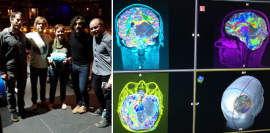
I’ve been thinking a lot lately about how to stimulate my silly brain to prevent it from getting mushy from all the fun upcoming therapies. I decided to use language in addition to playing the piano. First up is Spanish because at least I have a head start from back in school. My dad has the Rosetta stone for Spanish and my cousin is already fluent, so I have practice options. This should help me start filling up the grapefruit. The other day I got the idea to learn Braille because my eyes get strained fairly easily, but also because the tactile stimulation should activate additional pathways in the brain. I have no idea how someone goes about learning Braille and now it is something I’m slightly fascinated by. It’s not really something you can do on a standard computer, right? It requires actual physical bumps on a page right? I must make a trip to a book store or a library to investigate this. For now, I’m imagining the options while I picture Denzel reading the Bible in The Book of Eli. Interestingly, if you Google Braille, the first thing that Google shows after the solo word is “Braille on steering wheel”. Now that’s unexpected. Apparently back in 2009 people were discussing whether Braille appears in some vehicles. Someone else in the human factors community definitely knows more than I about what is going on with regard to research in that area…it certainly is an interesting thing to ponder, especially as we move toward self-driving cars…I wonder if being able to read Braille will somehow be a good zombie apocalypse skill as well…
Author: yourhandinmind

Life’s little (or big) coincidences
Yesterday I was sitting in a mall people watching, like I’ve done a million times before. Except this time my mind was focused on something different. I was thinking about how many of those people walking past me have some kind of disability and how many disabilities are not visible to the naked eye. Almost twenty years ago, when applying to graduate school, my plans were to do research on and design technologies to support people with disabilities. I was heavily influenced by one of my best friends being in a major accident and wanting to change the world for people who had different abilities. Once I got to graduate school, my career took a different path and I wound up working with different populations/user groups. Yet now, my life has come full circle and I find myself IN that original group of people I was focused on. Isn’t life interesting?
I know that I look the same as I did before part of my brain was taken out. I still talk the same, I have the same sense of humor, I am still the same person (well, now that I’m off those damn steroids). Yet I am not the same person. My vision is blurry. I can’t see to the left at all. My cognitive processing is a bit slower and I can’t multi-task nearly as well as I used to. I definitely won’t be driving anytime soon.
If I were one of the people walking by me in the mall, I would not have picked me out of the crowd as someone who has a disability at all. And I reminded myself that just because someone isn’t in a wheelchair or some other recognizable tell, it doesn’t mean that they aren’t dealing with something incredibly difficult every single day of their lives. And in that moment, sitting in the mall yesterday, I appreciated my life that much more. We’re all awesome in our own ways.
Why healthcare matters
As someone who has been pretty healthy all of my life until recently, I haven’t spent much time thinking about healthcare. I’ve always had employer-provided insurance. Clearly this has been a hot topic in the news of late and I’m paying closer attention as it could impact my short and long term care.
Recently, I heard the story of a woman who switched insurance companies and was then no longer able to see her neurosurgeon any longer. You heard that right. She was no longer able to see the doctor who performed her brain surgery, to keep him in the loop with her health so that he could continue to be involved in her care. She wound up lapsing in her care and her tumor regrew to the point where it was inoperable. This story was told to me by a neurosurgeon.
I also recently heard the story of a woman in a clinical trial who was unable to continue in the clinical trial because she moved from one state to another and the new state had different legislation about participation in clinical trials. This story was relayed by a doctor involved in oncology clinical trials.
None of us likes to think about the possibility that we might have an illness or require short or long term disability in some way. But I went into the hospital one day and had brain surgery three days later and now I have radiation and chemotherapy treatments in my future. Anything is possible.
Even the seemingly small things that will be in whatever healthcare bill gets passed are important. We should all be paying attention, regardless of our individual political views.
Learning lots of things I never really needed to know before…
The last week or so has been full of travel and doctor’s visits. I’ve learned about radiation therapy and the differences between photon and proton therapy. I’ve learned about chemotherapy. I’ve learned more about brain tumors in general. Did you know that May is Brain Tumor Awareness Month?
I’ve also learned that more people in Philly get the Key and Peele A-A-Ron reference on my shirt than in other places. Go Philly!
There were a few more fun things from the brain book that I found interesting and wanted to pass along…
- The claim we only use 10% of our brains is totally false. We use it all and often multiple parts at the same time.
- Anarchic Hand Syndrome (AHS) is when a person no longer has conscious control of one hand and it appears to move on its own (think Dr. Strangelove or, I suppose, Evil Dead).
- There are 6 different kinds of aphasia (inability to produce and/or comprehend language). The particular issue that sent me to the ER was called Production Aphasia – the inability to articulate words or string them together. It is caused by damage to Broca’s area.
- Einstein’s brain was removed after his death and found to be wider than normal and was missing a part of the deep groove that runs through the parietal frontal lobe. The area affected is concerned with mathematics and spatial reasoning, and it is possible that the missing groove allowed his neurons to communicate more easily.
- It takes more than 20 years for the brain to become fully mature. Although we know teenage brains aren’t fully formed, it is good to remind ourselves of this every once in a while.
- The brain is a magnificent organ in general. I certainly took mine for granted prior to A-A-Ron…
 Your Hand in Mind