Category: Uncategorized

My wacky visual system

I have mentioned I have a wonky eye.  What does that mean? Prior to surgery, we were told I may lose some of my peripheral vision, specifically in the upper and lower regions.  I remember the neurosurgeon saying that I may have some trouble walking initially because of the lower left periphery.  Mom remembers him also saying upper.  Regardless, when I came out of surgery, I had lost my entire left periphery.  That means literally someone can be right next to me on the left and I can’t see them.  I have my foveal (center) vision in my left eye, but if I am looking straight, I can’t see something on the left at all unless I turn my head and look at it with both eyes. My left eye is also a little wonky in that is is a constant kaleidoscope, with lots of interests lights and colors constantly happening.  I see Disney woodland creatures and sometimes horses and unicorns, depends on the day.  It also looks like the left side of everyone’s face is melting off, which is entertaining. Looking at myself in the mirror is a real hoot.  It reminds me of when the Terminator is missing the left hand side of his face and he sees the metal and his mechanical eye.

There are two main effects of my wonky vision.  The first is that I can’t sit up straight anymore.  I have learned the role of my visual system in holding me up straight.  Because I have no left periphery, my entire body now leans to the left side when I am sitting.  That means that the visual system plays an important role in keeping me up straight and with the loss of part of it, my body doesn’t know what to do. I have to use lumbar support pillows, I have some chairs that actually hold me up straight, or I have to prop myself up with these awesome, thick bamboo pillows I have.  It also means that by the end of the day, my back is killing me, especially between the shoulder-blades.   I have learned to deal in various ways.

The other effect is that my Where’s Waldo skills are now just pathetic.  My visual field is a big blur of lots of stimuli that is hard to distinguish.  I used to have such an attention to detail and that is just completely gone.  In a crowded place, the chances of me finding a single person or thing are minimal unless that person is waving his or her arms or there is something colorful or shiny to draw my attention. I have had to train my mom to use military clock terms to help orient me spatially…look at 3 o’clock or 11 o’clock. I also need much more context in conversations than I used to, because of my inability to recognize objects like I used to previously.  She can’t point to something across the room and have me easily follow the line to what she’s talking about unless she tells me what I’m looking for. It’s all interesting and amusing.

I just realized the other day that even though my left eye is the wonky one, it also has better visual acuity than my right eye, I assume because I’m left side dominant.  So, I tend to favor my left eye when I’m looking  for something.  This becomes entertaining because I literally don’t see things that are right in front of me unless I am told they are there. And I can wander around my apartment looking for something for hours and not see it. I know it is there somewhere. If something is slightly out of place, it throws me off completely. Things that used to be so easy and second nature are totally different now.

If I weren’t a psychologist and a researcher by nature, this stuff would likely be much more frustrating.  But to me it is all rather fascinating.

Being a left-handed vs. Left-brained?

I am left-handed.  Have been my whole life. My brother is as well.  I am pretty ambidextrous though. When I was young and played softball, I would get up to bat and not remember which way to stand and my mom would have to yell out to me.  I do a lot with my right hand. But, I’m left side dominant for sure. I put my left shoe on first, my left leg goes in my pants first, I write with my left hand, etc. So it was rather surprising to me when, prior to the surgery, the nurses and doctors at the hospital kept asking me  if I was sure I was left-handed. I must have been asked half a dozen times. They just didn’t seem to believe me.

The tumor was on the right side of my brain and I had come in with speech issues, so I assumed it had something to do with where they expected my speech areas to be in the brain of a left-handed person. Time to consult my brain book!

Alright. 10% of the population is left-handed. Of the left-handed population, about 70% process language on the left side of the brain, while the other 30%  process language equally between both sides.  So I am in the minority and it makes sense why they would have been asking me.  It also means, as my friend, Ro, pointed out to me, that I’m extremely lucky.  If  I wasn’t in that minority, then who knows when we might have discovered that A-A-Ron even existed.  The sheer fact that he was pushing on one of my language areas and gave me aphasia meant that we found him.  I’ve been quite lucky since this happened, over and over again.  Here is yet another example of things that just worked out in my favor. And I’m going to continue to welcome those things. 🙂

The moment I knew I was experiencing something extraordinary

When I woke up from my brain surgery, there was something in front of me that was confusing.  It looked like it might be a  face, but there was something off about it. I found myself trying to figure out this mystery.  I started looking at the individual features of this thing in front of me.  Eventually I realized that I was indeed looking at the face of an OR nurse who looked strange because she had a surgical mask pulled down underneath her face.  Her face looked strange to me because it had an extra component that was unexpected. In that moment, I realized I was watching my brain using bottom up processing to compensate for some jacked top down processing and that I was literally watching my brain work, consciously watching my brain actively processing.  MIND BLOWN. No pun intended.

As a psychologist, a scientist, and a n academic, this is pretty freaking cool. I also know it isn’t normal at  all.

For those of you not familiar with human cognition and information processing or those of you that took Intro to Psych so long ago you’ve just forgotten, our brains process information via top down and bottom up processing simultaneously and automatically without us having to consciously do anything necessarily.  Top down processing is how we apply meaning to the world around us based on our expectations and experiences.  It happens without us really knowing about it.  All the visual stimuli you see, lines, colors, shapes, etc. become objects you recognize through your top down processing.  This allows us to see the Gestalt or big picture, as opposed to just a bunch of lines and dots and meaningless things.  On the other hand, bottom up processing is the interpretation of your visual field based on each individual feature that you see.   Taking the face as an example, with top down processing, we automatically recognize a face because we are already wired to.  But my wiring was wacky and so I wasn’t automatically recognizing the face in front of me.  I watched my brain actively switch to bottom up processing and I started analyzing the image in front of me, the two eyes, the nose, the shape, and finally the chin, which then had the mask underneath it.  Once I was able to recognize the mask was a separate entity, I was able to recognize the face for what it was.

This also manifested itself in me really being grounded by a standard wall clock.  I knew exactly what it was supposed to look like, so if it looked different for some reason, like for instance when the 2 and 3 were right next to each other at one point, I knew this was just my perception being wonky.  I knew it wasn’t reality.  However if I was looking at the counter and saw two cups, I didn’t necessarily know if there were two cups in reality or I was seeing double vision.  Conversely I had a really hard time with balloons for the first couple of days.  Balloons don’t have a standard, expected shape.  They come in different sizes and shapes, and different numbers of balloons in bunches.  They are also floating, so they aren’t necessarily at the same height.  I had to have all balloons removed from my field of view because they confused me, especially in the middle of the night when I woke up. So clock yay and balloons no way for the first week after surgery.

I have continued to see my brain compensating for the mismatch of information coming from the bottom up processing based on my wonky left eye and the lack of expectations that come from my wonky top down processing.  It is fascinating.  There doesn’t seem to be an actual word for this.  Every word I can find related to cognition is a noun.  I spent sometime looking up Latin and Greek roots last night and decided I need to come up with my own word for consciously watching my own brain actively process. I have already gotten some feedback from some smart people but I welcome additional thoughts on this particular issue. It needs to be a  verb, not a noun.  Thoughts?


Introducing A-A-Ron

Some quick facts about me, my tumor (A-A-Ron), and life post-surgery

  • On March 15, 2017,  I had some trouble finding my words.  It was the second time that it happened and so I became concerned.  I was familiar with the relationship between aphasia (difficulty with speech) and stroke because years ago one of my fellow graduate students had a stroke at 32 years old and my aunt had a mini-stroke (TIA – transient ischemic attack) earlier in 2016.
  • I contacted my mom and told her what happened.  She told me to get myself to the ER immediately. I called an Uber and was at the local ER within the hour. I was not thinking I would be there long. I debating taking a magazine to read and a sweatshirt because it would be cold in the waiting room. I texted my boss and said I’d be unavailable for the remainder of the afternoon as something had come up.
  • I walked up to the check in counter in the ER and told the nurse that I needed to check myself in because I had experienced some aphasia.  It was hen I learned that aphasia is not a common term.  She asked me to explain.  I said I had trouble finding my words.  The nurse on the other side of the wall overheard, put me in a wheelchair immediately and I was in a CT scanner within 10 minutes.  That is when I was told I had a “large mass” in my brain.
  • Turns out that I am lucky to live near one of the leading neurology hospitals and was transferred there within 2 hours. It was my first ambulance ride.  My User Experience (UX) brain was observing everything and asking the women all kinds of questions about how they work in the ambulance and what kinds of workarounds they had. They had a phone charger in the ambulance!
  • AS they wheeled me into the ICU in the sister hospital, I overheard one of the staff members say, “Is this the massive tumor from Alexandria”? I thought to myself, “I guess that’s me” and Well that is probably not the user experience that they want patients to have.” That is how I went from a large mass to a massive tumor.
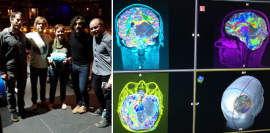
  • The following morning, 12 hours later, I finally had an MRI and learned that I had a tumor so large it had probably been there for 2 decades. My brain had just accommodated around it all these years. It was not the largest tumor they had ever seen, but I was certainly on leaderboard.
  • Three days later, on Saturday, March 18, I had brain surgery to remove A-A-Ron. The surgery was supposed to last 7-12 hours.  I was done in 4.5 hours due to A-A-ron being much more “suckable” than expected. However, brain surgery is an art and they were not able to get him out completely.  They got about 80% of him out, leaving a hole in my brain approximately the size of a grapefruit. I came out of the surgery with a wonky left eye and no left peripheral vision whatsoever.
  • Three days later, on Tuesday, March 21, I was sent home.  You heard that right.  Three days after brain surgery, I was sent home.  I was in the hospital from Wednesday to Tuesday. I’ve been home ever since, recovering from brain surgery and experiencing the most incredible things that I will now share with you on here.